|
| |
|
On behalf of HM Government I send you grateful thanks for all the hospitality and friendship extended to British delegation at Crimea Conference... No previous meeting has shown so clearly the results which can be achieved when the three heads of government meet together with the full intention to face difficulties and solve them. You yourself said that co-operation would be less easy when the unifying bond of fight against a common enemy had been removed. I am resolved, as I am sure the President and you are resolved that the friendship and co-operation so firmly established shall not fade when victory has been won. Winston Churchill, in a telegram dated 17 February 1945, thanking Stalin for his 'hospitality and friendship' at the Yalta Conference.
During the War, Britain and the USA were allies of the Soviet Union but the only thing that united this so-called 'Grand Alliance' was their hatred of Germany.
The 'Big Three' – Churchill, Roosevelt and Stalin – held three conferences – at Tehran (1943) Yalta (February 1945) and Potsdam (July 1945) – to try to sort out how they would organise the world after the war. It was at these conferences that the tensions between the two sides became increasingly obvious.
|
Going DeeperThe following links will help you widen your knowledge:
Personalities at the Conferences - especially important if you are doing OCR
Powerpoint: • The differences between Yalta and Potsdam
|
Tehran (1943)It was the first time the three leaders had met. There were tensions: Churchill was worried that Stalin was manipulating Roosevelt, and he stormed out of the meeting because Stalin proposed executing 50-100,000 German officers so Germany could never go to war again.
The allies agreed:
|
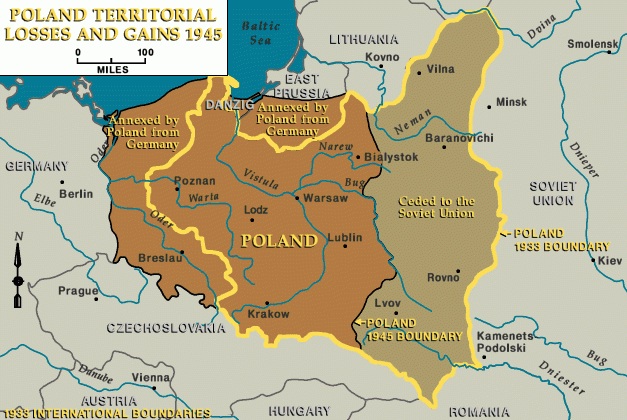
A map showing the boundary of Poland in the 1930s (in yellow), and Poland as decided after WWII (land coloured brown).
|
Yalta (Feb 1945)Held during the war, on the surface, the Yalta conference seemed successful. The Allies agreed a Protocol of Proceedings to:
At Yalta, the negotiations went very much in Stalin's favour, but this was because Roosevelt wanted Russian help in the Pacific, and was prepared to agree to almost anything as long as Stalin agreed to go to war with Japan. Therefore, Stalin promised that:
Although the Conference appeared successful, however, behind the scenes, tension was growing, particularly about reparations, and about Poland. After the conference, Churchill wrote to Roosevelt that ‘The Soviet Union has become a danger to the free world.’ And on their return home both he and Roosevelt were criticised for giving away too much to the Soviets:
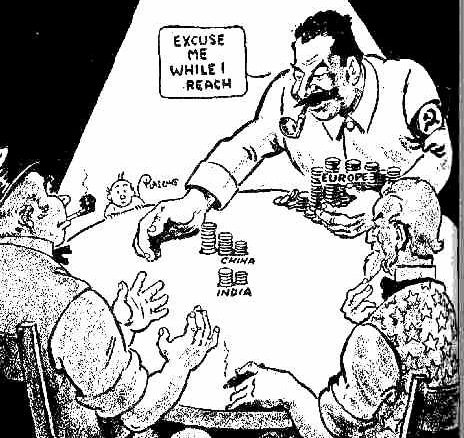
Source BThis cartoon by the American cartoonist Paul Plaschke appeared in the Chicago Tribune, shortly after the Yalta Conference. It shows Stalin playing poker with Churchill and Roosevelt. Click here for the interpretation
|
Yalta Conference
- straightforward narrative account of the Conference
Operation Keelhaul - one of the darker decisions of the Yalta Conference. Famous picture (and its modern spoof).
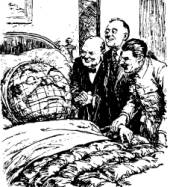
Source A‘How are we feeling today?’ – a British cartoon of 1945 shows Churchill, Roosevelt (USA) and Stalin (USSR) as doctors, working together to heal the world. Click here for the interpretation
Consider:1. Does Source A prove Britain, Russia and America were friends? 2. Write two reports of the Yalta Conference: one for the British government, the other for the British newspapers.
|
Potsdam (July 1945)At Potsdam, the Allies met after the surrender of Germany (in May 1945) to finalise the principls of the post-war peace – Potsdam was the Versailles of World War II. Three factors meant that the Potsdam Conference was not successful:
So, at Potsdam, the arguments came out into the open.
The Conference agreed the following Protocols:
President Truman presented it as a 'compromise', but in fact the Allies had disagreed openly about:
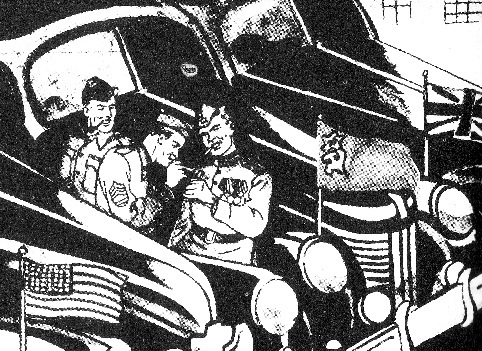
Source EThis cartoon was published in the Soviet magazine Krokodil on 30 July 1945, three days before the end of the Potsdam Conference. Click here for the interpretation
|
Potsdam Conference
- straightforward narrative account of the Conference
Source CThe Russians only understand one language - ‘how many armies have you got?’ I’m tired of babying the Soviets. President
Truman, writing in January 1946
Source DNow I know what happened to Truman yesterday. I couldn't understand it. When he got to the meeting after having read this report he was a changed man. He told the Russians just where they got on and off and generally bossed the whole meeting. Churchill, talking
- on 22 July -
about Truman's behaviour on that day
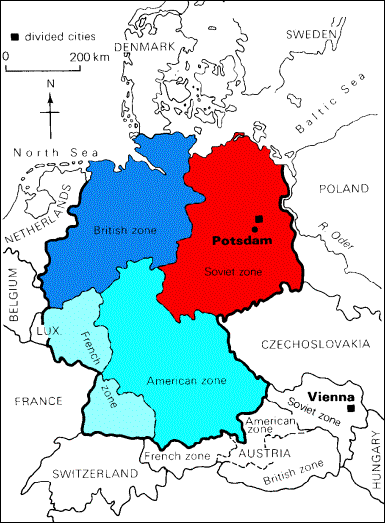
A map of how Germany was divided into zones
Did You Know?In 1945, an election in Britain returned a Labour government, so Churchill was replaced by the Labour leader and new Prime Minister Clement Atlee - a man whom Churchill described as: 'a modest man, with a lot to be modest about'.
|
Consider:3. Discuss the differing attitudes and interests of the three leaders at Potsdam. Why was the Potsdam Conference less successful than the Yalta Conference? 4. If the Potsdam Conference was full of tensions and arguments, why did Source E present it as happy and friendly? 5. The historian Alan Bullock (1991) thought that 'Stalin's diplomatic successes at Yalta and Potsdam were as great as Hitler's in the 1930s'. Do you agree?
|
|
|
|
|
|
Spotted an error on this page? Broken link? Anything missing? Let me know. |
|