|
|
A Failure of the LeagueWhen you studied the League of Nations, you learned that it had two great failures in the 1930s - Manchuria (1931) and Abyssinia (1935). However, by far the greatest disaster for the League was
|
|
Hitler's foreign policy should not have been a surprise to students of Mein Kampf. Despatch 3165 from the American Embassy in Berlin, 24 December 1936.
|
Going DeeperThe following links will help you widen your knowledge: Debates on Hitler's foreign policy Hitler's Foreign Policy - by T Ferenczi Hitler's Foreign Policy Aims - Sources
|
|
Many historians think that Hitler was from the start determined to try to destroy the Treaty of Versailles and the League, and that it is doubtful if anything could have stopped him or averted war - i.e. that the Second World War was 'Hitler's War'.
Hitler had three aims:
| |
1. To abolish the Treaty of VersaillesThe Germans hated it, especially:
The Treaty was a constant reminder to the Germans of their humiliation in World War I. Hitler labelled it "eine Schande und Schmach … eine unerhörte Ausplünderung unseres Volkes" ('a shame and a disgrace ... an unprecedented plundering of our People'). He did not accept that the German army had lost the war, and was determined to overturn Versailles and make Germany great again.
|
Source AThe Versailles Treaty is worthless. 60 million German hearts and minds are on fire with anger and shame. They will cry out ‘We want war!’ Mein Kampf (a book written by Hitler, 1924).
|
2. To expand German territoryThe German population was growing. Hitler said that the German nation needed more Lebensraum (‘living space’). He was determined to get Lebensraum by conquering land in eastern Europe. This was connected with his belief that the Aryan race was genetically superior and destined to rule over others. Hitler believed he had the right to invade eastern Europe and make the Slav peoples (such as the Poles and the Russians) Germany's slaves.
|
Source BIt will be the duty of German foreign policy to get large spaces to feed and house the growing population of Germany. Hitler, Mein Kampf (1924).
|
3. To defeat CommunismThe Nazis were Fascists: the exact opposite of the Communists who ruled Russia. Hitler blamed the Communists for Germany's defeat in World War One, and he feared that the Communists were trying to take over Germany. He was determined to destroy Communism, and this meant a war with Russia.
|
Source CThe menace of Russia hangs over Germany. All our strength is needed to rescue our nation from this international snake. Hitler, Mein Kampf (1924).
Consider:1. Match Sources A-C to Hitler's aims (1-3). Explain how each source illustrates its matched aim.
|
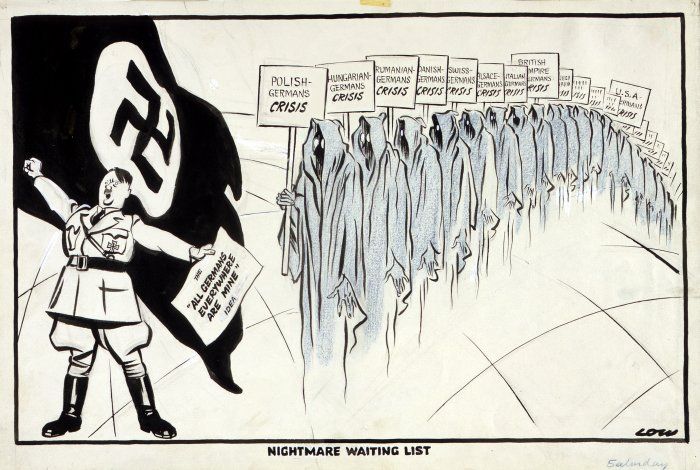
Source D
This cartoon by the British cartoonist David Low appeared in the Evening Standard newspaper on 9 September 1938. Hitler on the left, in front of a Nazi flag, waving a sheet of paper marked 'The Idea. All Germans everywhere are mine'. Behind him stands a long line of ghostly figures, each carrying a placard marked 'Polish Germans - Crisis', 'Hungarian Germans - Crisis' etc with 'British Germans' and 'U.S.A. Germans' further down the line. Click here for the interpretation
|
Consider:1. Study Source D - it suggests a further motivation of Hitler's foreign policy (pan-Germanism). What does it suggest on the surface that Hitler was trying to do?
|
|
|
|
|
Spotted an error on this page? Broken link? Anything missing? Let me know. |
|