|
|
NOTE: this topic is a stated topic on the AQA and Edexcel specifications. It is NOT a stated topic on the OCR specification, though it is essential pre-knowledge.
|
|
In November 1918, the German navy mutinied. Rebellion spread throughout the country. On 9th November Kaiser Wilhelm abdicated and fled the country; a new Republic was declared. Elections were held for a new Reichstag on 19th January 1919, and on 11th February 1919, in the town of Weimar, a new government was agreed, with Freidrich Ebert as elected President. On 11 August 1919 he signed the new Constitution. Germany did not just get a new government. The Allies made sure that Germany got a different kind of government. Before1914, the government of Germany looked like a military autocracy; but after 1919, it aimed to be a parliamentary democracy.
|
Going DeeperThe following links will help you widen your knowledge: This webpage gives an overview of the Weimar years 1919-33
The Weimar Constitution - selected clauses AS level notes - good ideas
YouTube Make Germany Pay is the best way to an overview of the Republic during the years 1919-1928 Pete Jackson on Weimar 1919-29 - really good
The Weimar Constitution - content, strengths and weaknesses
Germany 1919–1933The history of Germany 1919–1933 falls into three phases: 1919–1923At first the Weimar Republic had great difficulties: • Left wing rebellions • All people were angry with it • Right-wing rebellions and terrorism • Invasion and inflation • Munich Putsch 1923–1929But the Republic survived and (after Gustav Stresemann became Chancellor in 1923) did well: • Economic Prosperity • Foreign Policy successes • Cultural flowering 1929–1933After the Wall Street Crash of 1929, however, the Republic collapsed: • Unemployment • Nazi Party grew more powerful • In 1933, Adolf Hitler became Chancellor
|
|
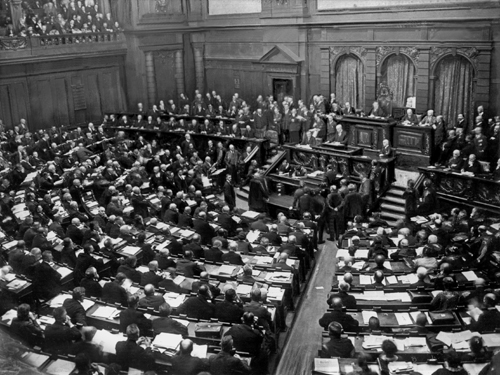
Elected delegates meeting in the Reichstag in February 1927.
|
|
Germany’s Constitution before 1914 (simplified)
|
Source APrinciples of the Weimar Constitution Article 1: The German Federation is a republic. Supreme power emanates from the people. Article 17: Every state must have a republican constitution. The representatives of the people must be elected by the universal, equal, direct and secret suffrage of all German subjects, men and women. Article 109: All Germans are equal before the law. Article114: Personal freedom is inviolable. Article118: Every German is entitled within the limits of the general law freely to express his opinions... Article135: All inhabitants of the Federation enjoy full liberty of faith and of conscience. Article151: The organization of economic life must accord with the principles of justice and aim at securing for all conditions of existence worthy of human beings.
Source BThe Constitution was a brave attempt to set up a democratic government… All Germans had equal rights, including the vote. Political parties were given seats in proportion to the number of votes they got. This was fair. A school GCSE textbook, Germany 1918-1945 (1997) |
The Weimar Constitution of 1919
|
|
What historians have said about the Weimar Constitution
Source CThe Weimar Republic was a last-ditch attempt to institute a Western-style deomcracy in Germany. But it was doomed from the start... To conservatives, reactionaries, socialists and communists alike, Weimar was merely a stopgap to be discarded once the revolution (from left or right) took place. Amrican historian Michael Zimmermann, Confrontation with Modernity (1990)
Source DOne of the basic difficulties of the republic was that it changed the government and political system of Germany overnight from an authoritarian system based on the personal rule of the Kaiser backed by the army, to a democratic parliamentary system of which Germany had no real experience. The new parliamentary system was based on proportional representation, which encouraged the growth of minority political groups, making a parliament of many parties… The German government had to depend on changing, unstable, parliamentary coalitions A school revision book by PJ Larkin, European History (1965).
Source EThe Weimar constitution combined the continuity of traditional institutions and the introduction of progressive civil liberties. The civil service, judiciary and the education system were all preserved in their old form. And, as the vast majority of bureaucrats, judges and professors were luke-warm or indeed actively hostile to the republic, powerful conservative forces were able to exert a high degree of influence. Retired head of sixth form Geoff Layton, From Bismarck to Hitler (1995)
Source FThe Weimar Constitution was a hodge-podge of principles drawn from Socialist and liberal agendas ... it was doubtful such a democratic constitution could work. German-American historian Klaus Fischer, Nazi Germany, a New History (1995)
Source GThe Groener-Ebert deal (10 November 1918) In the evening I telephoned and told Ebert that the army put itself at the disposal of the government, that in return ... the officer corps expected the government to fight against Bolshevism. Ebert accepted my offer of an alliance. [The Army officers] hoped through our actions to gain a share of power in the new state. If we succeeded we would have rescued into the new Germany the best and strongest elements of old Prussia, despite the revolution. The task was to contain and render harmless the revolutionary movement. General Wilhelm Groener, Memoirs (written in the 1930s)
|
Did You KnowA Metaphor for Weimar? When the Republic was formed, it was suggested that it should be celebrated by a national holiday, and that 11 August (the day in 1919 Ebert signed the Constitution) would be a good date. However, Conservatives wanted 18 January (the day in 1871 the Reich had been formed). So – even though celebrations were held on 11 August each year all over Germany – the Bill to make it a national holiday failed in the Reichstag in 1923, and in the years after. German historian Marlene Bloch (1995) notes the irony that “a celebration to create political unity was doomed to failure from the start”.
Consider:1. Discuss with a friend how the Weimar settlement changed Germany's constitution in the following areas:
2. Study the diagram of the Weimar Constitution and Sources A & B, and make a list of all the strengths and opportunities you can see. 3. Study Sources C-F, and make a list of all the weaknesses and threats undermining the new Constitution. Why is Article 48 in red? 4. Weigh the strengths & opportunities against the weaknesses & threats; explain your reasoning. 5. Study Source G. I find it a chilling and depressing document. Explain how the revelations in this source would support a verdict that the Weimar Republic was "dooned from the start".
|
|
| |