|
| ||
Early explanations largely or entirely assumed that the outbreak of the war could be explained in terms of Hitler's relentless nationalist ambitions, central to Nazi ideology, which led to careful plans for European domination. Ted Townley, Hitler and the Road to War (1998).
It is like travelling through thick forest with millions of trees. You are on the motorway which passes through quickly and easily. You are aware of another, earlier road. But as for the forest? Presumably there are tracks, and you can see a little way in through the first line of trees, but – even though you have driven through it many times – most of the forest is an unknown, even forbidding mystery.
|
Going DeeperThe following links will help you widen your knowledge: The Great Depression as a cause of war PJ Larkin (1965) has a section on the underlying causes of the War, including a good section on the Great Depression 'Why World War II?' - explores issues beyond Hitler
|
|
1. THE MOTORWAY: HITLER’S WAR?In 1998 Collins published a book for A-Level History entitled Hitler and the Road to War. To be fair to Ted Townley, the author, he does tell us on the first page that: "The outbreak of war in September 1939 can no longer be explained simply in terms of Hitler’s actions and policies." … but, nonetheless, the first two-thirds of his book are about Hitler’s actions and policies, and to this day these remain the focus of popular histories, TV documentaries, school textbooks ... and GCSE specifications.
SO… the ‘motorway route’ to the Causes of WWII is:
|
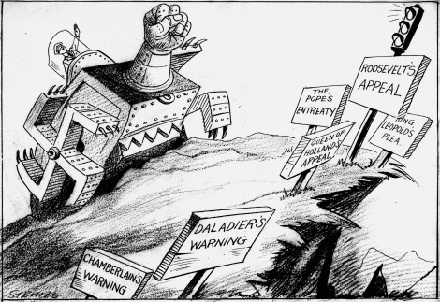
This drawing by the British cartoonist Sidney 'George' Strube (2 September 1939) is titled 'Juggernaut'. What did Strube think was the cause of the war? Click here for the interpretation |
|
2. THE OTHER ROADYou know from your studies that there ARE other issues involved in the outbreak of WWII:
… but even in the most-recent AQA GCSE History syllabus they are treated as separate to ‘the origins and outbreak of the Second World War’, and it is easy to regard them therefore as a separate road. Yet people in the 1930s did not see these issues as separate, in silos. For them, Italy invaded Abyssinia just after Hitler’s Re-armament Rally, and just before he marched into the Rhineland. And as late as 1937 the League set up a Reform Committee to discuss how it might adapt to the changed political situation. SO… don’t forget to mention these two factors.
|
Consider:1. How might you go about devising criteria to help you to weigh the various factors - to decide which are more impotant than others? 2. For each factor, think about HOW they helped to cause the war, and its impact in doing so; which do you think was most important, and why? | |
3. THE WHOLE FORESTFinally, what about the rest of the forest – all the Other Issues troubling the peace in the 1930s. What about the Civil War in Spain? The weakness and collapse of the fledgling democracies in eastern Europe? The role of the USSR? Meanwhile, have we forgotten that the Second World War was a
world war, not a European war, and that
Japan – creating havoc conquering an empire in the Pacific,
and committing all kinds of war crimes in China – was a key factor in its
outbreak AND in November 1936 formed the ‘Axis’ alliance with German and
Mussolini … but hardly gets a mention in the classroom narrative, even though
the Axis Alliance was explicitly intended for war. And has it not struck you that – when you were studying the outbreak of World War One – you started by studying the ‘underlying issues’: Nationalism, Imperialism, Militarism and Alliances? All these tensions were important in the 1930s – so why are we not asking whether there was a general ‘will to war’ as we did for WWI? What about the Great Depression of the 1930s – did that create a situation in which war was more likely? And what about beliefs & ideologies: the historian Mark Mazower thinks that a key factor in the outbreak of war was the ethical clash between the easy-going (for the times) liberalism of the British Empire and the repressive supremacism of the German one Hitler was building. Mazower called his book: ‘Dark Continent’, and the people who lived through the 1930s saw them as a time when evil was triumphing all over the world and it was going to be a case of fighting for civilisation … or losing it.
The specification demands that you show a knowledge of Hitler’s policies & actions, and of the failure of the Treaty of Versailles, the League of Nations & Appeasement. But when you have covered the basics, you might want to drop a few sentences to show that you are aware of THE WIDER PERSPECTIVE.
Consider:1. Plan the essay: 'Why did war break out in 1939?'
2. Now, can you adapt the information in your essay to a slightly different form: 'Was the policy of appeasement the most important reason for the outbreak of the Second World War?'
|
|
|
|
|
||
|
Spotted an error on this page? Broken link? Anything missing? Let me know. |
| |