|
|
|
|
There is an argument amongst historians about whether Hitler intended war or not. Immediately after the war, historians such as Alan Bullock (Hitler, A Study in Tyranny, 1952) argued that Hitler had intended war from the beginning, and that he had worked inexorably and determinedly towards it. But that was not the only explanation. Even during the war, a group of Labour politicians led by Michael Foot had published The Guilty Men (1941), which blamed Chamberlain and the appeasers for allowing – even encouraging – Hitler to move towards war. In 1961, A.J.P. Taylor’s The Origins of the Second World War (1961), went even further. Taylor argued that Hitler was not an isolated madman, but simply continuing a policy of German expansionism. And he accused Western leaders, not just of allowing Hitler, but of causing the war – virtually entrapping Hitler into war. By contrast, German historians of the time were accepting the blame for both world wars; in 1965, German historian Andreas Hillgruber claimed that Mein Kampf (written by Hitler in 1924) contained Hitler's Stufenplan (his 'step-by-step' plan) for world domination. By 1985, Ruth Henig, in The Origins of the Second World War could claim ‘general agreement’ that ‘the ambitions of Hitler constitute the major element in the outbreak of war’. There are still ‘functionalist’ historians such as Ian Kershaw who argue that general underlying forces were more important than Hitler’s personal role, but nowadays most historians seem to accept Hitler’s responsibility in causing the war. In 2004, Christian Leitz, in Origins of World War two – Responsibility of the Powers: Nazi Germany, argued that Hitler possessed ambitious plans for the domination of Western Europe … with a ‘diabolical’ racial twist.
|
|
The Cartoonists’ ContributionBut was it obvious at the time that Hitler had a Stufenplan for world domination? If he had, it is a remarkable fact that Hitler continually seemed to be taking the rest of the world by surprise!
David LowOne contemporary who consistently argued that Hitler intended to go on and on, and that he would not stop until he was stopped, was cartoonist David Low. Low hated Hitler, and the feeling was returned with such intensity that Hitler tried to get Low’s cartoons proscribed – so it is arguable that his cartoons ‘touched a nerve’. But did even Low spot a Hitler Stufenplan? Many of Low’s cartoons carry the idea of ‘sequence’, and it is instructive to see the idea developing in his cartoons, but it is hard to argue that Low had ‘rumbled’ Hitler:
|

|
26 June 1933 |
|
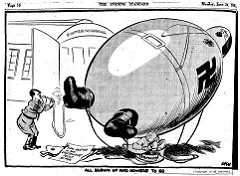
This cartoon from the beginning of Hitler’s chancellorship, is entitled: ‘All blown up and nowhere to go’. The paper on the ground reads: ‘Total absence of any constructive policy so far’. Far from an evident Stufenplan, if Hitler had a strategy, it was not evident to anyone yet. |
|
3 July 1936 |
|
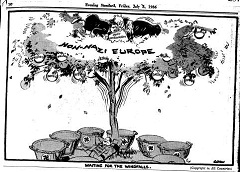
We then hear nothing that even sniffs of a ‘sequence’ until this cartoon: ‘Waiting for Windfalls’, four months after Hitler had remilitarised the Rhineland. In the cartoon, Western Leaders sit precariously in the ‘Non-Nazi Europe’ tree, pursuing a policy of ‘Shaky Statesmanship’, while Hitler waits below for the apples (some with the names of different countries) to fall into his baskets. This is the first of many cartoons which became a well-worn theme for Low: if you fail to stand up to Hitler, then other countries will fall to Nazism. However, Low clearly did not think that Hitler
had a ‘sequence of acquisition’ in his mind.
The naming of the apples is random (from left to right:
Czechoslovakia, Danzig, Holland, Austria,
Sweden, Indeed, the whole concept of the cartoon is that the apples will fall randomly (as apples do), and that Hitler is merely ready to collect any that do, as they do. |
|
8 July 1936 |
|
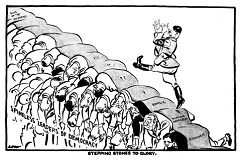
Five days later, Low’s famous ‘Stepping Stones to Glory’ showed Hitler marching towards his goal (‘Boss of the Universe’) along a carpet laid across the backs of the ‘spineless leaders of democracy’. Here at last is a clear claim that Hitler is travelling down a ‘road’, and Low has even identified the first two steps correctly – ‘Rearmament’ and ‘Rhineland’. But Low was able to do so because those were the two steps Hitler had already taken. He guesses Hitler’s next step (Danzig) incorrectly, and the rest of the steps are marked with question marks. Low was claiming that Hitler was heading down a road, but he had no idea where he was going. |
|
19 November 1937 |
|
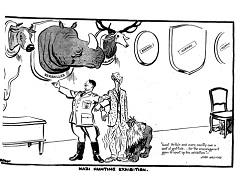
Here again, a year later, we see the idea of a sequence of ‘killings’, but the victims this time are the post-war settlements Hitler has wrecked – Weimar, Versailles and Locarno – not countries-to-conquer. Again, Low is unable to guess where Hitler will go next – there ARE plinths ready for future gains, but they are simply labelled ‘reserved’. Low was claiming that Hitler was heading down a road, but he had no idea where he was going. |
|
8 July 1938 |
|
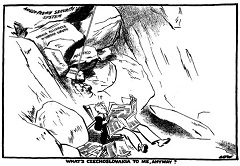
As the Sudetenland crisis began, Low warned again of the implications of allowing Hitler to win. In this famous cartoon, ‘What’s Czechoslovakia to me anyway?’, he portrays a British public unbothered by the fact that the stone labelled ‘Czechoslovakia’ is just about to be pulled out, unaware that this will bring down a sequence of others. But what of the sequence? The stones Low names here are: ‘Poland’, Rumania’, ‘etc. etc.’, ‘French alliances in eastern Europe’ and ‘Anglo-French security system’. The message is not that Hitler has a planned sequence of acquisition (and if he did, Low has not a clue what it might be), but that allowing him to win in Czechoslovakia will – ‘down the line’ – compromise Britain’s security.
|
|
9 September 1938 |
|
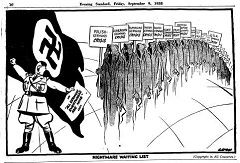
As the Again, the cartoon is a general warning about the consequences of not saying no to Hitler, rather than a prediction of where Hitler will go next – the crises are labelled: Polish, Hungarian, Rumanian, Danish, Swiss, Alsace, British Empire… |
|
10 October 1938 |
|
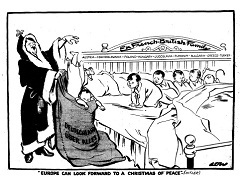
Not until after Munich was Low able to predict with any degree of correctness where Hitler was going to go next as, in this famous cartoon, he listed the ‘Ex-French-British family’ along the bed-head – Austria (gone), ‘Czechoslovakia’ (being ‘bagged’), with Poland next in line. By this time, however, fairly much everyone could see where Hitler was
heading, although it was February before the British government sought
assurances over the |
|
12 December 1939 |
|
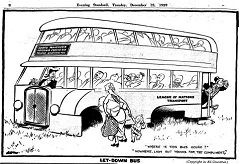
Finally, after war had broken out, and when
Low had the benefit of hindsight, he drew this cartoon of the As the ‘route’, Low listed the following
sequence: Corfu, Manchuria, It is relevant that Low depicted the cause of war, not as a Stufenplan by Hitler, but as a progression of failures by the League? |
|
It is clear from Low’s cartoons that – although Low correctly predicted that Hitler intended to carry on with his expansionist policy until there was a war – he was not aware of any set plan that Hitler was following. I think it is fairly obvious from the cartoons that Low’s opinion was that Hitler was taking advantages of opportunities as they came along, as they were presented to him by the ‘spineless leaders of democracy’.
Other Cartoonists |
|
|
9 September 1939 |
|
Shortly after war
broke out, the British cartoonist The cartoonist can see that Hitler has acquired the Saar, the Rhineland, the Sudetenland, and Memel, and he sees him as gaining Danzig and Warsaw. This, however, is not a very perceptive insight almost three weeks after Hitler had invaded Poland, and – as far as I am aware – there is no other Strube cartoon which (as Low) accused Hitler of beating a path to war. |
|
15 March 1940 |
|
Similarly, the British cartoonist Illingworth, in this cartoon of early 1940, suggests a ‘sequence of acquisition’ – but, again, only after the war had broken out. Here, he depicts Rumania, Denmark, Norway, Sweden, Belgium and Holland lined up and ready to be swallowed. Yet even now – six months into the war – he is able only to predict that Hitler WILL strike again ... but he hasn’t a clue where. |
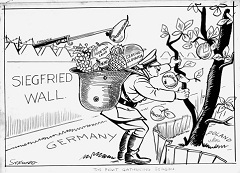
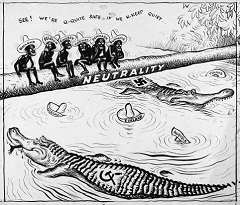
|
British cartoonists often depicted the dictators as predators – alligators, tigers, big fish eating smaller fish. Their portrayal of Hitler reveals how British people felt subconsciously about Hitler, who was shown as an animal, hunting and murdering, or as a greedy megalomaniac, boasting and devouring. What he was NOT shown as was as a strategist – a chess-player, or a general. I think this shows that, subconsciously, the British people felt/knew that Hitler was dangerous, yes, but they did not sense that he had a plan – indeed, it was his very unpredictability which made him so frightening.
|
|
|
| |