|
|
|
|
In July 1933, Hitler announced to the Reich Governors that the Nazi revolution was over: The achievement of outward power must be followed by the inward education of man... Revolution is not a permanent state. The full spate of revolution must be guided into the secure bed of evolution. In this the most important part is played by the education of the people. The present state of affairs must be improved and the people embodying it must be educated in the National Socialist conception of the State.
This was the Nazi concept of Gleichschaltung – 'bringing into line'. It was not just a matter of taking power; Germany, and the German people, had to be TRANSFORMED by National Socialism. Everything they, did, said and thought had to be brought into line with National Socialism.
The first part of this was for the Nazis to take total political and social control:
|
Going DeeperThe following links will help you widen your knowledge: BBC Bitesize webpages on Propaganda and Opposition
Simple pages from my KS3 series
Was Hitler a 'weak dictator'? - difficult but VERY important article
Podcasts
YouTube Hitler establishes power - BBC video (watch the second half, from the 9-minute mark). Pete Jackson on Nazi control of Germany, and over the Churches
|
Six Ways to Control Germany[Possess The Power You Worthless Rogue]What were the levers that maintained Nazi control over the German population? Within a one-party state, Hitler used terror to keep power, underpinned by propaganda and indoctrination of the young. There were special measures to keep the workers happy. Hitler signed a Concordat with the Pope, which stopped Catholics opposing him.
1. Political control – the one-Party stateThe Enabling Act (23 March 1933) gave Hitler the power to make his own laws, which he used to make himself the all-powerful Fuhrer of Germany. The Law against the Formation of Parties (14 July 1933) declared the Nazi Party the only political party in Germany. It was an offence to belong to another Party. All other parties were banned, and their leaders were put in prison. Nazi Party members, meanwhile, got the best jobs, better houses and special privileges. Many businessmen joined the Nazi Party purely to get orders.
|
"Ein Volk, Ein Reich, Ein Fuhrer!" - one people, one empire, one leader.
|
2. TerrorThe Nazis also took over the local government and the police. On 26 April 1933, Hitler set up the Gestapo (the secret police), and encouraged Germans to report opponents and 'grumblers'. Tens of thousands of Jews, Communists, gypsies, homosexuals, alcoholics and prostitutes were arrested and sent to concentration camps for 'crimes' as small as writing anti-Nazi graffiti, possessing a banned book, or saying that business was bad. Germans learned to 'speak through a flower'. Even more terrifyingly, the Nazis believed in Sippenhaft (‘clan punishment’): if one member of the family broke the law, all the family was punished. In February 1934, the Law on the Reconstruction of the Reich abolished the Reichsrat, and all the powers of the German States (the Länder) transferred to Hitler. In April 1934, the new Treason Law created the the People’s Court (Volksgerichtshof), where handpicked Nazi judges (often without legal qualifications) openly criticised defendants, sometimes punished their lawyers for defendng them, and declared political sentences whatever the evidence. On the Night of the Long Knives (13 June 1934) Hitler used his legal power to assassinate all his opponents within the Nazi Party.
|
|
3. PropagandaSource ADuring a span of two decades, Nazi leaders showed the world bold new ways to use the weapon of propaganda. The Nazi Party’s advanced techniques influenced millions of Germans and other Europeans. Party members presented appealing visions of a New Order: a prosperous Europe led by Germany. At the same time, they demonized enemies, presenting them as threats to German society or western civilization. State of Deception: the power of Nazi propaganda, from the US Holocaust Memorial Museum website.
The German people were subjected to continual propaganda, under the control of Josef Goebbels . It was the cult of personality – everything was organised to make Germans permanently grateful to Adolf Hitler. Germans were made to feel part of a great and successful movement – in this respect the 1936 Olympic Games were a propaganda coup. The Nazis used the most up-to-date technology to get their message across.
|
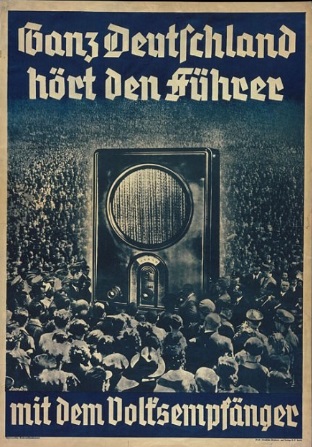
All Germany Hears The Führer with the People's Radio
Did You KnowAs soon as Hitler became Chancellor, Goebbels ordered the mass-production of a cheap radio – the Volksempfänger (People's Receiver) which sold for 76 Reichsmarks. Although this was equivalent to about two weeks' wages, by 1941 two-thirds of German households owned one. Alongside music, dramas, comedy and news, the Volksempfänger took Nazi propaganda direct into people's homes. It was designed only to receive local stations, and listening to forein/enemy radio was a crime (punishable by death during WWII).
|
4. YouthHitler boasted: 'When an opponent declares, 'I will not come over to your side', I calmly say, 'Your child belongs to us already'. The Nazis replaced anti-Nazi teachers and University professors, and school lessons included hidden indoctrination – requiring children to calculate how much mentally disabled people cost the state, or to criticize the racial features of Jewish people. German boys were required to attend the Hitler Youth, which mixed exciting activities, war-games and Nazi indoctrination. German girls went to the BDM and learned how to be good mothers, and to love Hitler.
|
Education for Death - wartime (1943) Disney anti-Nazi propaganda on growing up as a Nazi. |
5. WorkforceHitler banned all Trade Unions on 2 May 1933. Their offices were closed, their money confiscated, and their leaders put in prison. In their place, Hitler put the Deutsche Arbeitsfront (German Labour Front – DAF) which reduced workers' pay and took away the right to strike. The Reichsarbeitsdienst (National Labour Service – RAD) sent men on public works programmes. To keep the workers happy, the Nazis set up the Strength through Joy movement, which offered good workers picnics, free trips to the cinema and (for the very few) free holidays.
|
|
6. ReligionHitler wanted to replace religion with Nazism; this was an essential component of the German people’s Gleichschaltung into the Volksgemeinschaft. This led to a Kirchenkampf (Church Struggle)– this was regarded as vital, because it was a clash of ideology, not just a struggle for power. Hitler therefore: 1933: signed a Concordat with the Pope, agreeing to leave the Roman Catholic Church alone if it stayed out of politics. He immediately broke the agreement: • 1933: Catholic newspapers were banned. • 1934: when the president of Catholic Action, Erich Klausener, criticised the regime, he was assassinated. • 1935: Catholic Youth Clubs were restricted from all public activities. • 1935-36: the Nazis put hundreds of monks put on trial, accused of sexual perversions • 1936-37: crucifixes were removed from schools, and RE limited to two hours a week. • 1937: the Pope issued the statement: Mit brennender Sorge (‘With Burning Concern’) denouncing Nazi ideology and persecution. A furious Hitler ordered Catholic printing presses to be closed down, and hundreds of Catholics were imprisoned. 1934: tried to unite the Protestant churches into a single Reichkirche, taking charge of church finances and governance and appointing Ludwig Müller as its Bishop. • 1936: Martin Niemöller founded the Confessing Church, which attacked the regime. • 1937: Hitler banned the Confessing Church and arrested Niemöller and hundreds of pastors. 1935: dissolved the Watchtower Society of Jehovah’s Witnesses, • JW meetings were broken up, and a special Gestapo Unit assigned to infiltrate the organisation. By 1939, 6,000 Jehovah’s Witnesses had been sent to concentration camps. The Nazis failed to destroy religion; Church attendance increased under the Nazis.
|
BBC Bitesize on Nazi policies towards the Christian Church
|
|
| |